Branches of Astrology
Astrology is not a single discipline but a vast tree with many branches. From analyzing character to predicting events, discover the specialized fields of this ancient wisdom.
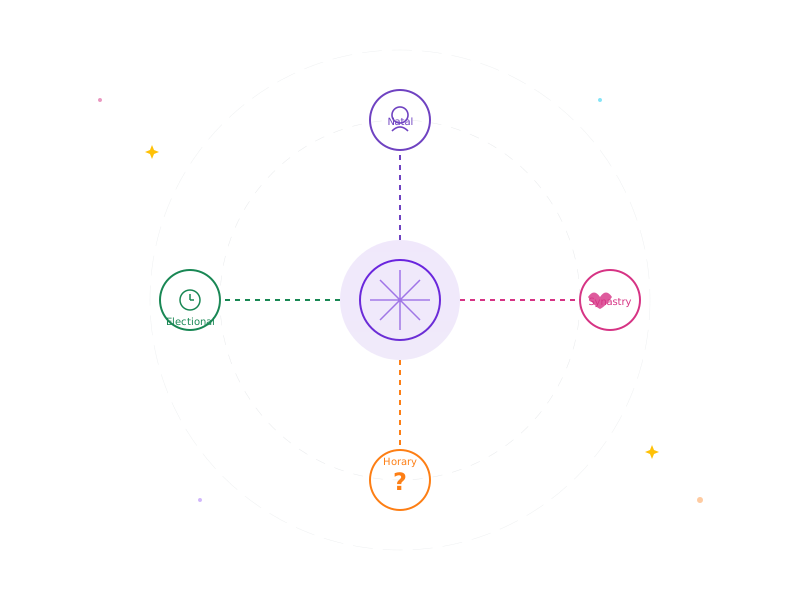
Natal Astrology
The study of an individual's birth chart to interpret their character, psychology, and life potential based on the celestial alignment at their exact moment and location of birth.
Natal Astrology, also known as Genethliacal Astrology, is the most widely practiced branch of the discipline. It is founded on the philosophy that the specific quality of time and space at the moment of a person's birth defines their nature and destiny. By calculating the exact positions of the Sun, Moon, planets, and sensitive angles (such as the Ascendant) relative to the Zodiac and the Earth's horizon, astrologers generate a 'birth chart.' This chart acts as a complex map of the human psyche, revealing inherent strengths, weaknesses, emotional needs, and the overarching themes that will manifest throughout the individual's life.
Historical Context
While early astrology focused on the fate of kings and nations (Mundane Astrology), Natal Astrology emerged as a distinct practice during the Hellenistic period (c. 2nd century BCE) in Alexandria, Egypt. The introduction of the Ascendant and the House system allowed for the personalization of horoscopes. It flourished through the Islamic Golden Age and the Renaissance before declining during the Enlightenment. It experienced a massive revival in the late 19th and 20th centuries, heavily influenced by the psychological theories of C.G. Jung, shifting the focus from fatalistic prediction to character analysis and self-actualization.
Key Focus
- Analysis of personality, temperament, and psychological complexes.
- Identification of innate talents, vocational aptitudes, and life purpose.
- Examination of relationship patterns and family dynamics.
- Assessment of physical constitution and vitality.
- Forecasting personal life cycles and developmental stages.
Ideal For
- Deep self-discovery and understanding personal motivations.
- Gaining clarity on life direction and career choices.
- Understanding recurring challenges or blocks in life.
- Navigating periods of crisis or transition.
- Improving interpersonal relationships through understanding compatibility.
Synastry (Relationship Astrology)
The art of comparing two or more natal charts to analyze the dynamics, compatibility, and potential challenges between individuals.
Synastry is a sophisticated branch of astrology that superimposes the natal chart of one individual onto another to determine how their energies interact. It operates on the premise that planetary positions at birth leave an energetic imprint, and when two people interact, these imprints create specific reactions. Synastry examines the geometry between planets (aspects) across charts and the placement of one person's planets into the other's houses (overlays). It provides deep insight into why we feel an instant connection with some and friction with others, covering emotional needs, communication styles, attraction, and karmic lessons.
Historical Context
While the comparison of charts for marriage suitability has ancient roots in Hellenistic and Vedic traditions (often for arranged unions), modern Synastry gained prominence in the 20th century. Influenced by the rise of psychological astrology, it shifted focus from predicting marital status to understanding the complex psychological interplay and compatibility between consenting partners.
Key Focus
- Emotional compatibility and safety (Moon interactions).
- Communication styles and intellectual connection (Mercury interactions).
- Physical attraction and romantic desires (Venus and Mars interplay).
- Long-term stability, restriction, and responsibility (Saturn contacts).
Ideal For
- Romantic partners seeking to understand their strengths and weaknesses.
- Business partners determining if they can work together effectively.
- Parents wanting to better understand and support their children.
- Analyzing the dynamics of friendships or rivalries.
Horary Astrology
An ancient branch of astrology that answers specific questions by analyzing a chart cast for the exact moment the question is understood by the astrologer.
Horary astrology is essentially an oracular system. Instead of analyzing a person's character or life path based on their birth data, it focuses on the 'birth' of a specific inquiry. The philosophy posits that the moment a pressing question arises in the mind and is communicated to an astrologer, the cosmos reflects the nature and outcome of that question. It requires a rigorous set of traditional rules to interpret planetary movements, strengths, and relationships to provide concrete answers, often including precise timing.
Historical Context
With roots tracing back to Hellenistic and Indian traditions, Horary astrology flourished during the Medieval period in the Islamic world and reached its peak in Renaissance Europe, most notably through the work of the 17th-century English astrologer William Lilly.
Key Focus
- Answering specific 'Yes' or 'No' questions.
- Locating lost items or missing persons.
- Predicting the outcome of specific events (e.g., lawsuits, transactions).
- Analyzing the dynamics of current relationships or rivalries.
Ideal For
- Finding lost objects like keys, jewelry, or documents.
- Making immediate decisions, such as 'Should I take this job?' or 'Should I buy this house?'
- Understanding the true feelings or intent of another person.
- Predicting the winner of a contest or legal battle.
Electional Astrology
The branch of astrology dedicated to choosing the most auspicious date and time to initiate a specific action or event.
Electional Astrology, often referred to as Inceptional Astrology, is the proactive practice of selecting a specific moment in time to begin an undertaking to ensure the best possible outcome. Based on the philosophy that the 'birth' moment of an event contains the seed of its potential and destiny, this branch allows the astrologer to construct a chart for the future. By aligning the start of a venture with favorable planetary configurations, the astrologer aims to maximize success and minimize difficulties.
Historical Context
This branch has deep roots in antiquity, tracing back to Babylonian and Hellenistic traditions, with foundational texts written by Dorotheus of Sidon in the 1st century AD. It was historically considered a high-stakes discipline, used by emperors to time coronations, by generals to launch military campaigns, and by architects to lay the foundation stones of cities like Baghdad. It remained a dominant practice through the Medieval and Renaissance periods before waning in the modern era.
Key Focus
- Determining the most favorable moment to act.
- Strengthening the planet that rules the specific activity (e.g., Venus for marriage, Mercury for contracts).
- Ensuring the Moon is in a strong position to facilitate growth.
- Avoiding planetary afflictions that could doom the venture.
Ideal For
- Scheduling weddings and marriages.
- Incorporating businesses or launching products.
- Signing major contracts or legal documents.
- Selecting dates for surgery or medical procedures.
- Purchasing real estate or laying foundations for a home.
Mundane Astrology
The oldest branch of astrology that analyzes world events, the fate of nations, politics, economics, and weather patterns.
Mundane Astrology, often referred to as Political Astrology, is the study of planetary cycles and their correlation with large-scale human events and natural phenomena. Instead of focusing on the individual psyche, it applies the principle of 'As above, so below' to the collective, treating nations, cities, and organizations as living entities with their own charts. It seeks to understand the rise and fall of empires, economic shifts, social unrest, and the general welfare of the state.
Historical Context
Tracing its roots back to ancient Babylon and Mesopotamia, Mundane Astrology was the original form of celestial study, where priest-astrologers advised kings on the fate of the kingdom, crops, and wars. It remained the dominant form of astrology through the Roman and Medieval eras before individual natal astrology became more popularized.
Key Focus
- Geopolitics, wars, and international relations.
- The economy, stock market trends, and business cycles.
- Social movements, public health, and the general mood of the population.
- Natural disasters, agriculture, and weather forecasting (Astrometeorology).
- The fate of political leaders and government administrations.
Ideal For
- Forecasting political outcomes and election results.
- Financial planning based on market trends and economic cycles.
- Understanding historical context and long-term societal shifts.
- Predicting potential periods of conflict or peace.
Medical Astrology
A specialized branch of astrology that correlates planetary positions with human anatomy, disease tendencies, and the timing of medical treatments.
Medical Astrology, historically known as Iatromathematics, functions on the hermetic principle that the human body (microcosm) reflects the solar system (macrocosm). It assigns rulership of specific body parts, organs, and systems to the planets and zodiac signs. The practice involves analyzing a natal chart to determine constitutional vitality and predisposition to certain ailments, or using specific charts to diagnose the nature of an illness and the likely prognosis. It emphasizes a holistic approach, often integrating the ancient theory of the four humors to balance physical and energetic health.
Historical Context
Originating in ancient Mesopotamia and Egypt, this tradition was further developed by Greek scholars like Galen and Ptolemy who linked the four elements to the four humors. During the Middle Ages and Renaissance, it was considered an essential science for physicians, with notable figures like Nicholas Culpeper formally associating herbal medicine with planetary influences.
Key Focus
- Mapping the twelve zodiac signs to specific body parts (e.g., Aries to the head, Pisces to the feet).
- Analyzing planetary influences on organs and physiological functions.
- Assessing the balance of the four elements (Fire, Earth, Air, Water) to determine humoral temperament.
- Predicting periods of low vitality or health crises.
Ideal For
- Identifying potential health vulnerabilities before they manifest.
- Selecting auspicious dates for elective surgeries or starting new health regimens.
- Holistic practitioners seeking to integrate herbalism and elemental balance into treatment.
- Understanding the energetic or psychosomatic components of physical symptoms.
Draconic Astrology
A specialized branch of astrology that maps the soul's purpose and spiritual heritage by calculating the zodiac starting from the North Node.
Draconic Astrology is often referred to as the 'Astrology of the Soul.' It utilizes a unique zodiac system defined by the Lunar Nodes rather than the seasonal cycle of the Sun (Tropical) or the constellations (Sidereal). By setting 0 degrees Aries at the position of the Moon's North Node, this system re-calculates the positions of all planets and points. Philosophically, it acts as a separate layer beneath the standard natal chart, revealing the unconscious motivations, karmic contracts, and the deeper spiritual impulses that drive an individual, distinct from their day-to-day personality.
Historical Context
While the importance of the Lunar Nodes dates back to ancient Babylonian and Vedic astrology, the Draconic Zodiac as a specific system is largely a modern development. It gained significant traction in the mid-to-late 20th century through the work of British astrologers like Ronald C. Davison and Pamela Crane, who systematized the method to explore karmic and spiritual dimensions of the horoscope.
Key Focus
- Analyzing the higher self and soul purpose.
- Uncovering unconscious emotional currents and spiritual drives.
- Identifying karmic patterns and past-life influences.
- Understanding deep-seated family or ancestral themes.
Ideal For
- Individuals seeking to understand their spiritual destiny.
- Analyzing deep, unexplainable connections in relationships (soulmates).
- Uncovering hidden talents or motivations not obvious in the natal chart.
- Resolving inner conflicts between the ego (Tropical) and the soul (Draconic).
Predictive Astrology
A specialized branch of astrology focused on forecasting future trends, events, and life cycles by analyzing the ongoing movements of celestial bodies.
Predictive Astrology involves the study of planetary movements to anticipate future developments. It is built on the philosophy that the natal chart (birth chart) is a seed containing potential, and predictive techniques reveal when that seed will blossom or face challenges. This branch does not necessarily imply a fixed, fatalistic future; rather, it provides a 'cosmic weather report,' allowing individuals to understand the nature of upcoming cycles—whether they are periods of expansion, restriction, change, or stability—so they can make informed choices.
Historical Context
Predictive astrology has its roots in Ancient Mesopotamia and Hellenistic Egypt, where it was primarily used to forecast the fates of nations and rulers. During the Medieval and Renaissance periods, complex systems like Primary Directions were refined by Arabic and European astrologers. In modern times, the focus has broadened to include psychological progression and personal growth cycles alongside concrete event prediction.
Key Focus
- Timing of major life events (e.g., marriage, career changes, relocation).
- Analysis of psychological and emotional evolution over time.
- Identification of favorable windows for action versus periods requiring caution.
- Understanding the cyclical nature of human experience through planetary returns and cycles.
Ideal For
- Strategic planning for business launches, investments, or major purchases.
- Preparing for significant life transitions or emotional shifts.
- Gaining perspective on current hardships by understanding their duration and purpose.
- Maximizing opportunities during favorable planetary cycles.